Towards regenerative architecture
White’s focus is on creating environments and architecture that are climate-neutral, circular, and that strengthen biodiversity, health and social value. Our vision is to move towards more regenerative architecture. We believe the built environment must be part of a cycle in which it is possible to strengthen and restore what already exists – whether that means ecosystems, raw materials, energy or social value.
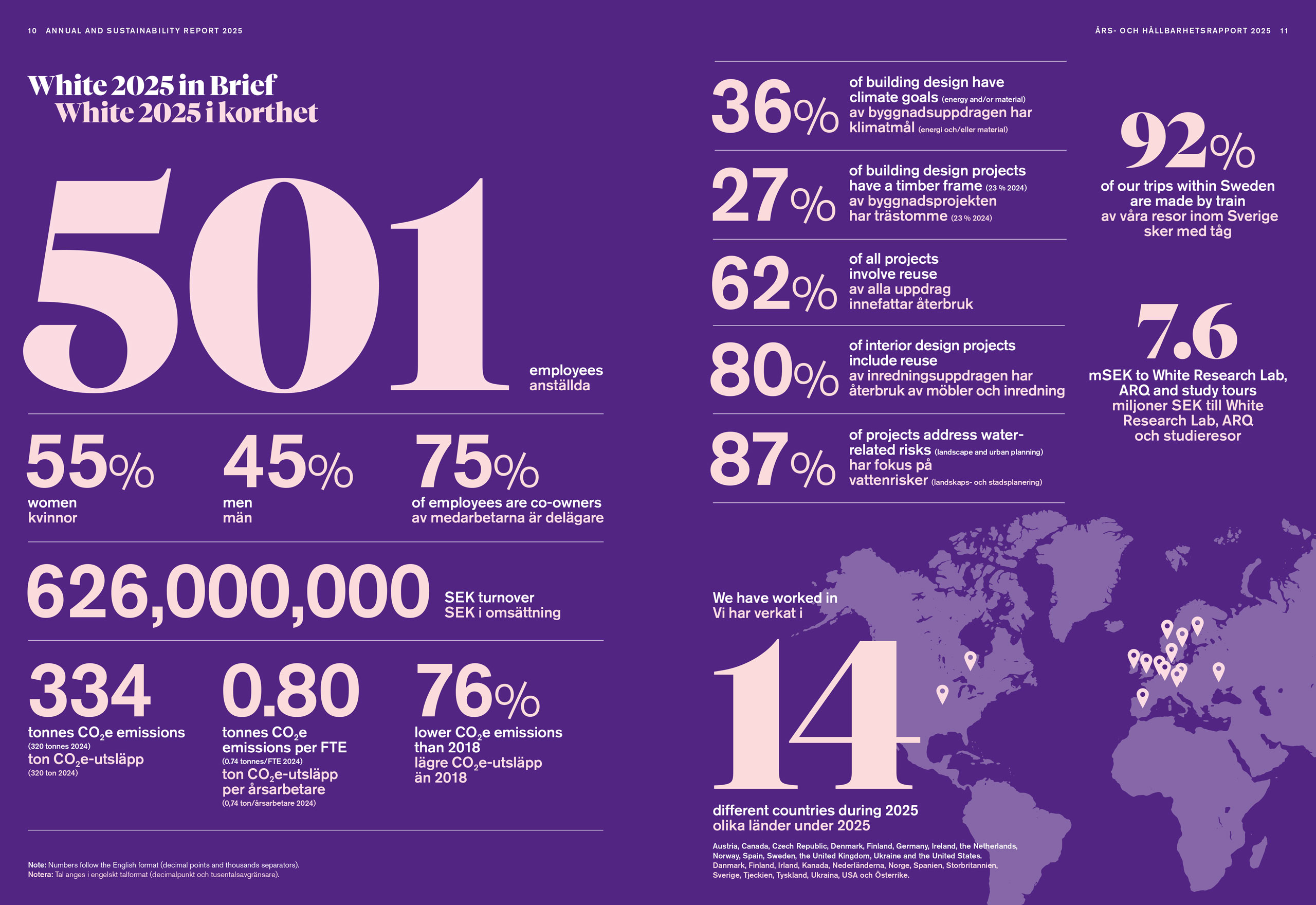
We are seeing strong movement across several of our focus areas, and during the year we increased the number of projects achieving high targets for reduced climate impact. 23% of our building commissions reach at least 20% lower CO2 emissions than Boverket’s 2023 median. By maintaining a strong focus on rail travel and sustainable procurement, we keep our operational climate impact low – 77% lower CO2 emissions than in 2018.
Raised climate targets, the need for resource efficiency, high vacancy rates and a weak economy are driving development towards more circular architecture. Last year, 62% of our commissions involved some form of reuse, with a strong emphasis on transformation. One example is our new Malmö office, which has moved into the old post office building. At Boverket’s new offices in Karlskrona, a large proportion of the existing interior has been restored and reused in the new premises. 80% of our interior design commissions involve reuse. We are also leading several projects as reuse coordinators and developing circular strategies.
Companies are setting ever higher climate requirements, and several cities are leading the way through land allocation processes. In Gothenburg, the new Arena Quarter is now taking shape, aiming for 70% lower climate impact, with a circular approach running through everything that is built. Another project with demanding climate requirements is Sonyas in Gothenburg – White’s new office and cultural centre.
Our project The Erven in the Netherlands has the potential to become a model for future regenerative urban development, and Wood City in Stockholm is aiming to become a climate-neutral neighbourhood. Timber construction remains strong, with 27% of our building projects using timber frames. The reception building at the new Central Hospital in Karlstad will become Sweden’s first permanent healthcare building with a timber frame. The Stadium area in Malmö is an example where we are working to create an energy-positive district that gives back more energy than it uses.
We are pushing hard for nature-based solutions to take up more space in the urban environment. They help strengthen ecosystems and biodiversity, manage climate risks, and create attractive and healthy environments. Climate adaptation is a focus in 87% of our urban planning and landscape commissions. Västergårdsparken is a new neighbourhood park in the emerging Järvastaden district in Solna, where a densely wooded area of varied terrain has been transformed into an inviting, green and multifunctional park for everyone. Another example is the Microparks on Regeringsgatan in Stockholm, where White has converted several parking spaces into small, welcoming park environments in the heart of the city.
Safety, wellbeing and socially sustainable environments are always relevant – and property owners are now beginning to set measurable targets for social issues too. Our approach is to involve citizens in the design process. In Hjällbo, Gothenburg, this has contributed to creating safer environments. In Torsås in Småland, we have designed Snödroppen – an independent residential development for older adults (trygghetsboende) with high sustainability ambitions and a design that promotes security and independence. In November 2025, Haus Hynsperg in Liederbach was inaugurated – White’s first completed project in Germany. The building offers serviced apartments for older or younger people with physical disabilities, as well as single parents with children. White remains a strong practice in healthcare architecture, and during the year we have been recognised for our design work and expertise in healing and inclusive architecture. Reuben Young People Centre in London, Queen Silvia Children’s Hospital in Gothenburg, Velindre Cancer Centre in Cardiff and Skåne University Hospital all received awards during 2025.
We hold to our vision that all our architecture will be strong in form, regenerative and climate-neutral by 2030. We are convinced this is possible – but we have only just begun the journey.