DeepDive: Modernising healthcare while maintaining operations – is it possible?

Is it possible to develop future specialist healthcare while continuing to provide care in the same buildings and on the same site? In Karlstad, this is precisely what is taking place. One of Sweden’s largest healthcare construction projects is progressing through careful planning, strategic collaboration and flexibility at every stage. Through close collaboration between Region Värmland, Skanska, and us the result is emerging and will be a guiding light for healthcare architecture for many years to come.

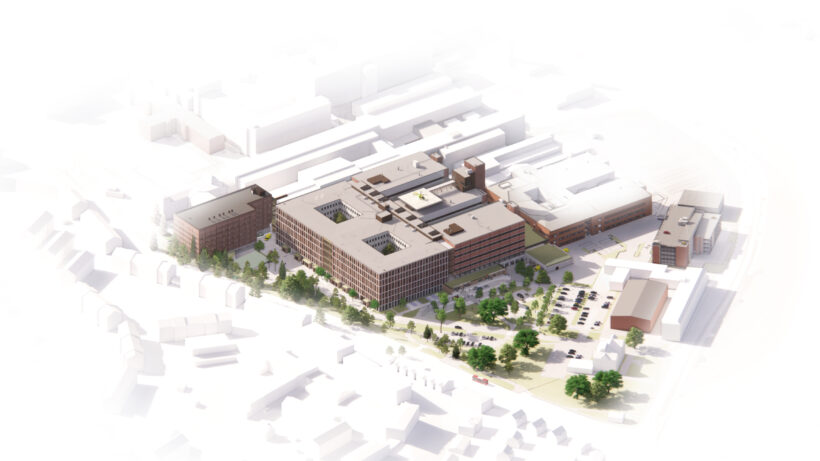
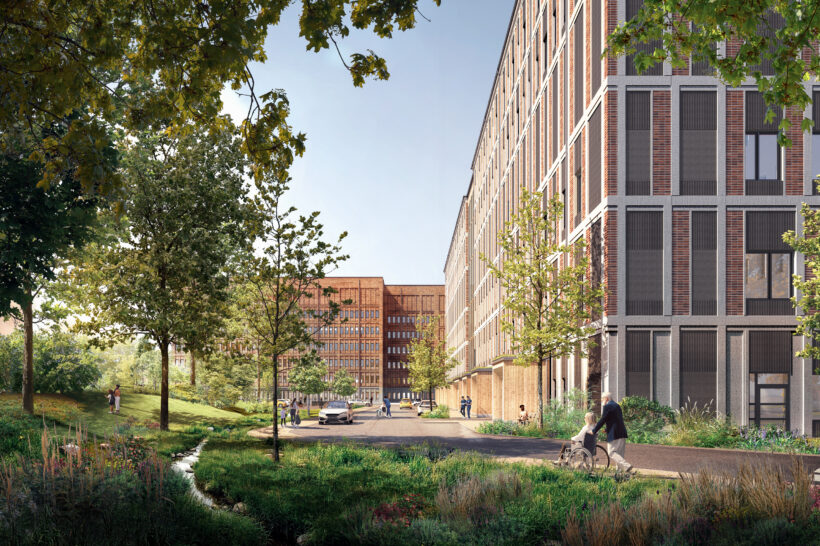
The extension and renovation of the Central Hospital in Karlstad (CSK) covers the entire hospital area: from the construction of a new emergency department, reception building, technical supply centre and car park to the renovation and demolition of existing buildings. A total of 100,000 square metres will be built, 14,000 square metres will be rebuilt, and 40,000 square metres will be demolished. This makes the hospital construction one of Sweden’s largest hospital development projects, where we are not only working on buildings but is also responsible for planning the landscape for the entire northern part of the site.

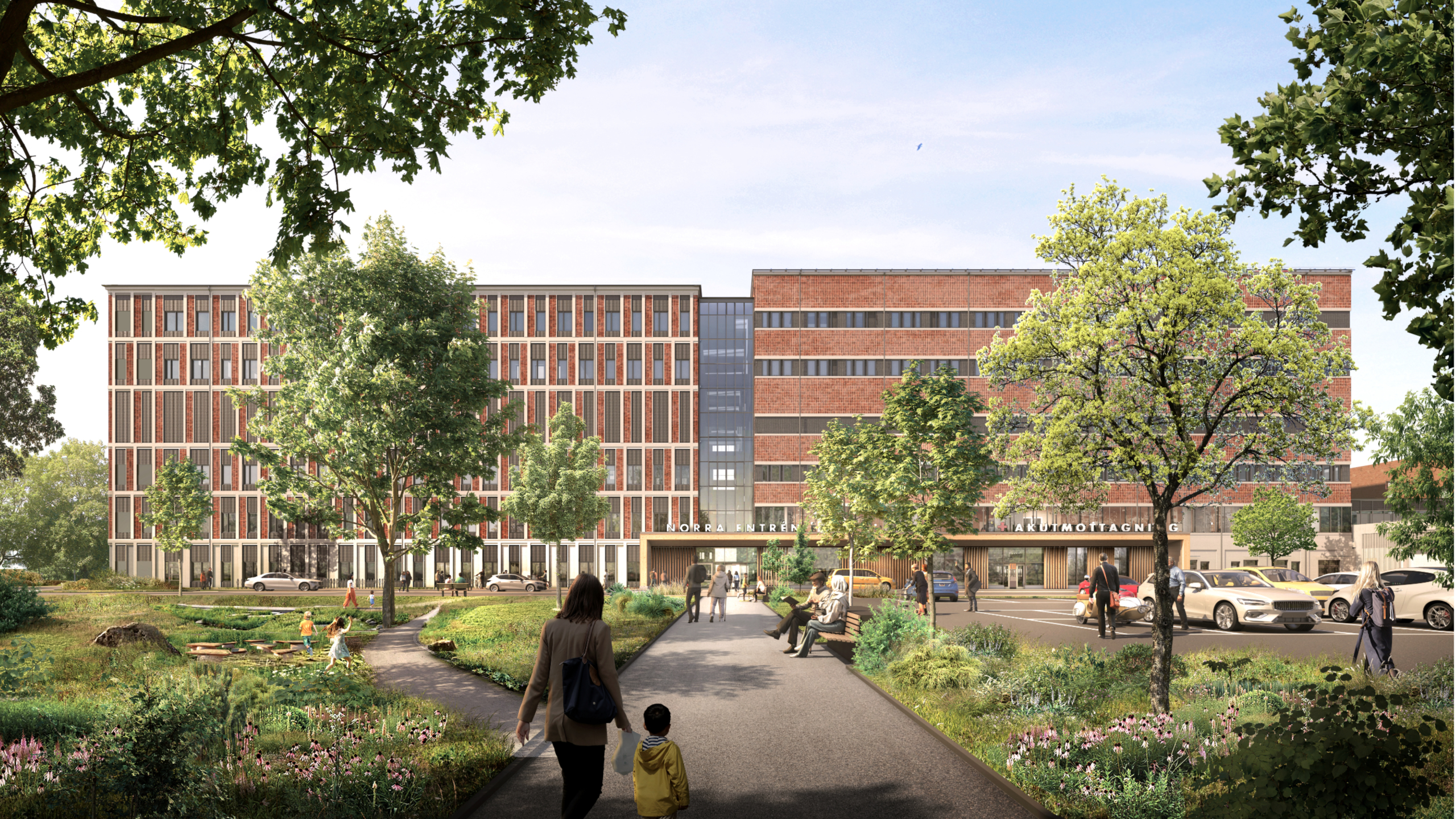
The Central Hospital in Karlstad, CSK, is characterised by transformative visions. One example is the Reception Building, which will be a pioneering project in Swedish healthcare architecture. It will be Sweden’s first permanent healthcare building with a timber frame, and its façade will incorporate more than 235,000 reused bricks. This sub-project illustrates how climate responsibility is aligned with Region Värmland’s rigorous sustainability requirements.
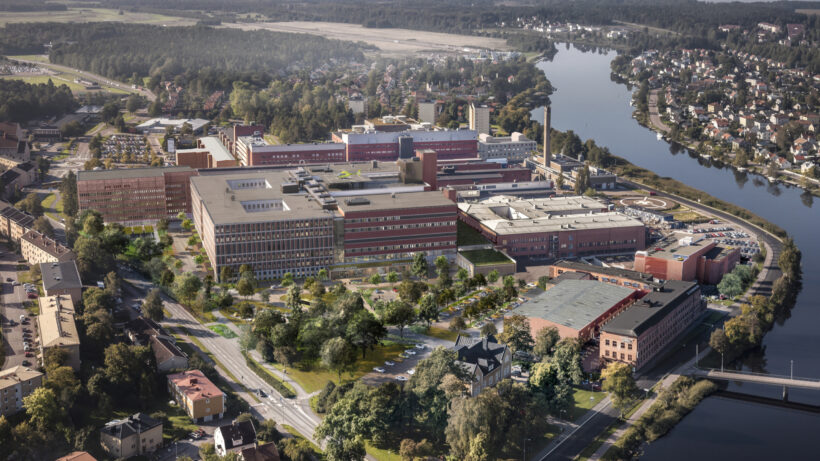
When completed, CSK will represent half a century of healthcare development. In 2001, an investigation was conducted into the relocation of the Central Hospital in Karlstad – but the plans were changed. In 2005, Region Värmland decided to develop the existing hospital site instead of building a new hospital. A deliberate choice that conserves both financial and environmental resources, while also creating a welcome sense of continuity and identity.

The project is being carried out in stages, in parallel with healthcare provision, which places high demands on meticulous implementation. This requires extensive collaboration between architects, contractors and the region to create long-term, flexible and robust solutions that both meet today’s healthcare needs and can be developed over a long period of time. Our experience of complex healthcare environments plays an important role here. Comprehensive expertise and continuity have been important throughout, with us involved in everything from overall planning and the development plan that sets out the strategic direction for the hospital, to the premises supply plan and the delivery of the project itself.

CSK will be the hub for specialist and emergency care in Region Värmland, and the largest of three emergency hospitals in a county of 283,000 inhabitants. In 2024 alone, 17 renovations were carried out as part of the project, while construction and design of the reception building began.

Generality as the key
In order to create a long-term functioning healthcare environment, social, ecological and economic goals need to be weighed up together. Generality is not just a technical strategy – it is a way of future-proofing healthcare. By designing buildings that can change over time, we create architecture that supports development rather than limiting it. A broad palette of principles and solutions that are developed should be able to be applied in several parts of the hospital and function when operations change, both in the short and long term.

The requirements for healthcare building projects are extensive, and the project must consider both normal and exceptional situations – everything from daily operations to pandemics and crisis situations. There are also high demands on perspectives such as children’s rights, infection control, radiation protection, safety and fire protection, among many other issues, and the buildings are designed with robustness and flexibility in mind on several levels, from floor plans to flows and technical infrastructure. This requires close cooperation between Region Värmland, the contractor Skanska and us.

An important principle throughout the project has been to maintain generality. The solutions we find should be applicable in many places in the project and work for the activities that will be there both today and tomorrow. Many of the lessons we have learned from building and developing while providing care can really be used when building new facilities.
Jens Axelsson, Deputy Lead Architect, White Arkitekter

By working from clear planning principles and developing them in close dialogue with the region, we have created a design system in which materials and categories are related to each other without every detail having to be determined in advance. In this way, the hospital can continue to develop in step with healthcare and contribute to an environment that promotes safety, comfort and well-being for all users, which, according to the Swedish National Board of Housing, Building and Planning, contributes to higher quality and more equal healthcare.

The design varies between public areas and healthcare facilities but is held together by a clear overall concept. Special care has been taken with the public corridors. Here, patients and visitors have been followed through the building to see how people move and orient themselves, with a carefully selected material concept with wood as the main tone and a mild, calm colour scheme. The ambition is to create a welcoming and timeless environment where healthcare, people and architecture interact over a long period of time.

Close cooperation and continuity have been crucial
While generality is a fundamental principle, it must be balanced with flexibility and a clear understanding of the needs of different activities. The project encompasses everything from urban development and urban planning to small renovations and interior design projects, where much of what is being built is also high-tech healthcare. This means that one sometimes must go into extreme detail. Close cooperation is therefore essential. Not only with Skanska and the region, but also with the staff who will be working in the premises.

The entire work process is designed to promote collaboration. It is characterised by continuous feedback and collaboration with the various departments, and a focus on clinical design to create environments that work effectively in practice. Our dialogue perspective runs throughout the entire project. Thanks to many years of experience from similar projects, a sustainable, effective and inclusive dialogue process has been developed.

Region Värmland has an established project process divided into three stages. In the first phase, strategic decisions are made about what will go into the building and how different functions will be located. In the second phase, the focus shifts to the departmental level to define what will be built there, and in the third phase, each room is designed in detail. This, together with our in-depth dialogue work, becomes an important quality guarantee – where collaboration with the parties involved ensures solutions that work in practice.

Mathias Nilsson, Project Business Director and Engineer with more than 20 years’ experience in complex construction projects, emphasises the importance of continuity and collaboration in the project.

We collaborate with many different stakeholders – from healthcare staff and union representatives to contractors and patient organisations. As the project progresses, the dialogue broadens, which is crucial for finding solutions that work in practice.
Mathias Nilsson, Project Business Director, White Arkitekter

Flexibility and basic principles
Another example of flexibility in practice at CSK is the co-location of care forms. Clinics, day care services and wards belonging to the same specialty are located close to each other, enabling staff to switch between workplaces and roles and strengthen collaboration to provide good care. This is a new working model and one of five basic principles on which the development of CSK is based. The principles were developed by us together with Region Värmland early in the process.

In 2019, we were involved in developing a needs analysis, property development plan and premises development plan for the area, which according to SKR, is the most fundamental tool for reducing ancillary costs and increasing efficiency in renovation and new construction in hospital areas. When Skanska joined as a collaboration partner in 2021, we returned in August 2022 to launch the plan together with the region and Skanska and continue developing the area.

Five principles governing the design of the new CSK

  • Optimal emergency connections – all activities that provide emergency care are gathered in the Emergency Building, for short distances and fast transport.
  • Large flows – activities that have many short patient visits will be located close to two large main entrances.
  • Proximity principle – care wards, reception and day care within the same specialty will be located close to each other to facilitate movement and contribute to collaboration within specialties.
  • Separation of flows – different movement routes for patients, visitors, staff and transport prevent collisions.
  • Co-location – activities with strong links, such as neonatal care and women’s healthcare, are located close to each other to streamline patient flows and facilitate collaboration between staff.

Five important lessons learned from the project

The development of CSK shows that collaboration, a long-term perspective, clear principles and structured methodology are crucial in large healthcare projects. We combine experience from previous national projects with local conditions in Värmland – and hopes to inspire other regions facing similar challenges. Some of the key lessons from the project include:

  1. Early principles and priorities create stability in planning and budgeting.
  2. By working with generality and flexibility in solutions, it is possible to enable future changes from an early stage.
  3. Collaboration between businesses, contractors and experts early in the process increases quality and efficiency throughout the project.
  4. Continuity in the team makes the process robust and creates a large pool of collective expertise and experience.
  5. In a project with large information flows, a structured approach is required to ensure that the right people receive the right information at the right time. This is achieved by building a team with clear roles and built-in redundancy for continuity.
We have had the privilege of being involved from the beginning – laying the foundations, establishing the structure and now turning the plan into reality. The continuity of the project is a strength. And the CSK is more than just a construction project. It is an investment in the healthcare of the future. For us, it is about creating environments that not only meet today's needs but also have the ability to grow and change in line with new working methods, technologies and the healthcare of the future.
Mathias Nilsson, Project Business Director, White Arkitekter

Timeline for new CSK
In 2001, a possible relocation of the Central Hospital in Karlstad was investigated. In 2005, Region Värmland decided instead to develop an updated hospital on the current site. Between 2017 and 2020, a preliminary study and programme document were carried out, which form the basis for the renovation, with us developing a property development plan and premises development plan for the area. Skanska joined as a collaboration partner in 2021. We returned in August 2022 to launch the plan together with the region and Skanska. In 2024, 17 renovations were carried out at the same time as the Reception Building was designed. Between 2024 and 2032, construction will begin on the Reception Building, parking garage, and Emergency Building, which is expected to be ready for patients in 2033.

Read more about the Central Hospital in Karlstad.

Cristiana Caira

Cristiana Caira

Key Account Manager, Architect

Göteborg

+46 31 60 87 77

Jens Axelsson

Jens Axelsson

Architect

Göteborg

+46 31 309 56 01

Mathias Nilsson

Mathias Nilsson

Building Engineer

Göteborg

+46 31 60 86 65

Please share!